How Were Military Families Supported in Previous Decades in the Usa
A smaller share of Americans currently serve in the U.Southward. Armed services than at any time since the peace-fourth dimension era betwixt World Wars I and Ii. During the past decade, as the armed forces has been engaged in the longest period of sustained conflict in the nation'south history, just half of one percent of American adults has served on active duty at any given time.1 As the size of the military machine shrinks, the connections betwixt armed forces personnel and the broader civilian population appear to be growing more than distant.
 While about Americans today take family members who one time served or are currently serving in the armed forces, at that place is a large generation gap on this measure out. In a recent Pew Research Center survey, more than three-quarters (77%) of adults ages 50 and older said they had an immediate family member –a spouse, parent, sibling or child – who had served in the military. For many of these adults, their military machine family unit members are probable to have served prior to the phasing out of the armed services draft in 1973.
However, adults under the age of 50 are much less likely to have family members who served in the armed forces. Some 57% of those ages 30-49 say they have an immediate family member who served. And among those ages 18-29, the share is only one-3rd.
This gap may be attributable in part to a life cycle effect – younger adults are less probable to take a spouse or a grown child, so they have fewer opportunities to have a family fellow member who has served in the military. They may accumulate more military machine family members equally they historic period. But even when controlling for these factors, the age gap persists. Adults nether age l who are married and those who have grown children are less probable than their older counterparts to report that these immediate family unit members served in the war machine.
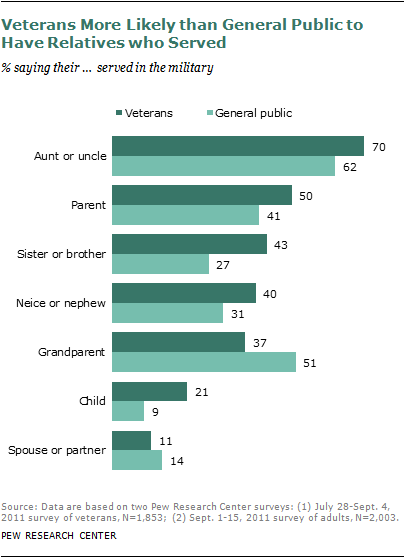 The Pew Research study also included a survey of military machine veterans. It institute that veterans are more likely than members of the general public to have family connections to the military. 7-in-10 veterans say they have an aunt or uncle who served in the military. This compares with 62% of all adults. Fully half of armed forces veterans take a parent who served, compared with 41% among the full general public. And 43% of veterans say they have a sister or brother who served in the military, compared with 27% of all adults.
The biggest gap in terms of family unit connections is in the share that has a child who has served in the military. Veterans are more than twice as probable as members of the general public to say they have a son or daughter who has served (21% vs. 9%). Members of the public are more likely than veterans to say they have a grandparent who served in the war machine (51% vs. 37%).
Overall, roughly eight-in-ten veterans (79%) take an firsthand family member who served in the armed forces. This compares with 61% amongst the general public.
This armed services-civilian gap is much wider amid younger respondents. Amidst those nether age twoscore, 60% of veterans have an immediate family member who served in the military. This compares with only 39% of all adults younger than 40. Amidst those ages forty and older, the gap is much smaller: 81% of veterans compared with 74% of all adults in that historic period group have an immediate family member who served in the armed forces.
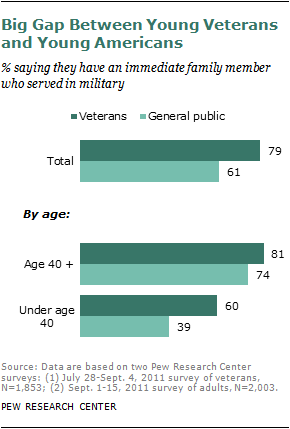 This suggests that the gap between veterans and the full general public in the share that has family connections to the military may be a relatively new phenomenon. With the shrinking size of the war machine in recent decades there are now fewer connections between the war machine and the civilian world. This is reflected in the relatively pocket-size share of immature adults (39%) with an immediate family member who has served in the war machine.
Do Family Connections Matter?
The survey shows that Americans who take family connections to the military have different views from those who don't on a range of topics related to patriotism, the military and national security. However, there are no meaning differences between the 2 groups in their views of the wars in Iraq and Afghanistan.
There is a widely held perception amid both veterans and civilians that the public does not understand the problems faced by those in the military. In the Pew Research surveys, 77% of veterans expressed this view, as did 71% of the full general public. Americans who have an firsthand family member who served in the military are more than likely to say the public doesn't empathise the problems service members face up. Some 75% of those with a war machine family unit fellow member say this compared with 65% of those who do not have an immediate family member who served.
Adults with family connections to the military are more than likely than those without these connections to consider themselves highly patriotic. Among those who accept a armed services family member, 42% say they are more patriotic than most people in the state. Only 30% of adults who do non have an firsthand relative who served in the military say they are more patriotic than near people. For their part, veterans are even more than probable to see themselves as highly patriotic: 55% say they are more patriotic than most other people in the country.
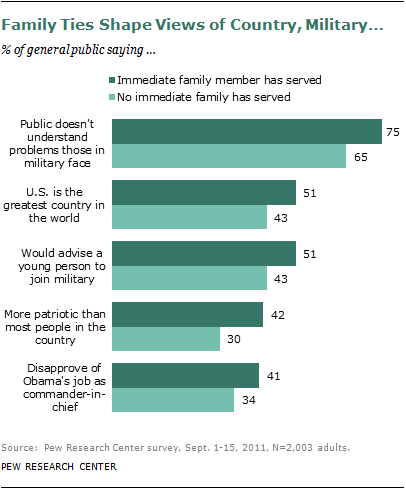 Having a family fellow member who served in the military is also associated with views most America'south continuing in the globe. Amid those with a family connection to the war machine, 51% say the U.Southward. is the greatest country in the world. Adults who do not have a family unit connection to the military are less likely to feel this style – 43% say the U.Due south. is the greatest land in the globe.
In addition, those who have an immediate family member who served in the armed forces are somewhat more likely than those who do not to say they would recommend a career in the military. Half (51%) of those with a family member who served say they would suggest a young person close to them to join the military. This compares with 43% of those who practise not accept a military relative. Amidst veterans themselves, fully 75% say they would recommend a career in the military.
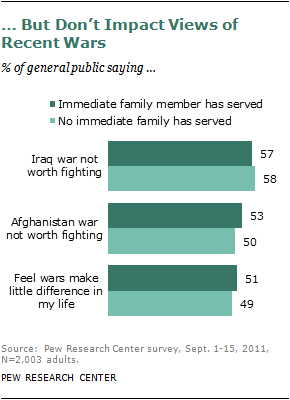 Those with family ties to the military tend to be more critical of the way Barack Obama is handling his job equally commander-in-chief. Even so, their views of the wars in Iraq and Afghanistan practise not differ significantly from those who do not have a family connection to the military. Amongst those with an immediate family member who has served in the armed forces, 41% say they disapprove of the style Obama is handling this aspect of his job. Fewer among those without a relative who served (34%) say they disapprove.
Overall, the public is skeptical that the wars in Iraq and Afghanistan accept been worth fighting. A 57% majority of all adults say the state of war in Republic of iraq has not been worth fighting, while only 36% say it has been worth it. And just over one-half (52%) say the war in Transitional islamic state of afghanistan has non been worth fighting, while 41% say it has been worth it.
 Those who take armed forces family unit members and those who practise non have virtually identical views on the wars. In add-on, a similar proportion from each group (51% of those with an immediate relative who served and 49% of those without ane) say they feel the wars have made picayune difference in their lives.
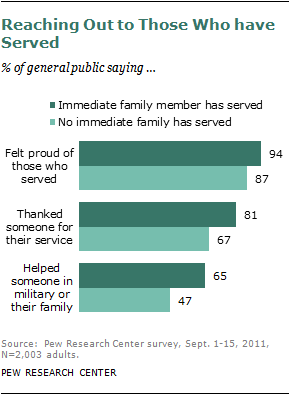
Putting aside their views on the wars, the survey finds that adults with family ties to the armed services are more likely than others to accept reached out to current members of the military machine and their families. Among those who have an immediate family fellow member who served in the military, 81% say they have thanked someone in the military for their service since the wars in Republic of iraq and Afghanistan began. Among those without a armed services relative, 67% say they take done this.
Roughly two-thirds of those with family ties to the military say that, since the wars began, they have done something to help someone in the military or a military family. Fewer than one-half (47%) of those without family ties to the military say they have reached out to aid a service person or a military family.
In improver, those with military machine relatives are somewhat more likely than those without military relatives to say that, since the wars began, they take felt proud of the soldiers who are serving in the armed services (94% vs. 87%).
Family Ties More Common Amid Some Groups
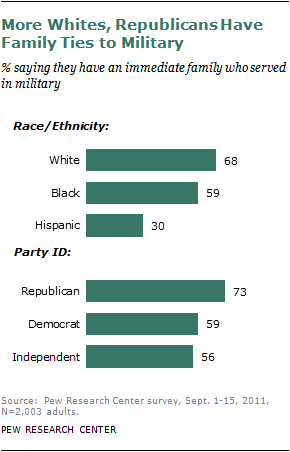 Overall, vi-in-x Americans (61%) have an firsthand family fellow member who has served in the military. Yet, some segments of the population are more likely than others to have these family unit connections. Whites are more than likely than blacks to take an immediate family member who served in the military (68% of whites vs. 59% of blacks). Hispanics are much less likely than either whites or blacks to accept family ties to the armed services – only xxx% say they take an firsthand family unit member who served.
Republicans are more likely than Democrats or independents to say they take a family connection to the military. Nearly three-quarters of Republicans (73%) say they have an immediate family unit member who served in the military. This compares with 59% of Democrats and 56% of independents.
In addition, those who live in the South (64%) are more than probable than those living in the Northeast (56%) or the West (57%) to say they have immediate family unit ties to the military. And city dwellers are somewhat less likely than those who live in the suburbs or in rural areas to say they accept a family member who served in the armed services.
About the Surveys
The Veterans Survey
Results regarding veterans in this report are based on a nationally representative sample of 1,853 men and women who served in the armed services and are no longer on active duty. The sample included ane,134 who were discharged from the armed forces prior to Sept. 11, 2001, and 712 veterans who served later 9/xi. (Seven veterans declined to respond when they served.)
The margin of sampling error for results based on the unabridged sample of veterans is plus or minus 3.5 percentage points.
Veterans were interviewed by telephone or via the internet. A full of 1,639 interviews were conducted over the phone nether the direction of Social Science Enquiry Solutions (SSRS). Respondents had been identified as veterans in before surveys conducted by SSRS and the Pew Research Centre and were re-contacted for the veterans survey. Of the total sample, i,307 telephone interviews were conducted on landline telephones and 332 on prison cell phones. Interviewing for the telephone survey was conducted from July 28 to Sept. 4, 2011. These interviews were supplemented by 214 interviews with veterans who served later 9/11 and are role of random sample panel of households maintained by the research firm Knowledge Networks. These online interviews were nerveless Aug. xviii-31, 2011.
The two data sets were combined and the unabridged sample weighted by SSRS to match known demographic characteristics of the veterans population as reported by the U.S. Census Agency. In addition, the postal service-ix/11 oversample was weighted back to reverberate its right proportion of the overall veterans population. A detailed caption of the survey methodologies and weighting strategy employed in this study can be found in "The Military-Civilian Gap".
The General Population Survey
Results reported for the full general population are based on phone interviews conducted with a nationally representative sample of ii,003 adults ages 18 or older living in the continental United States. A combination of landline and cellular random digit dial (RDD) samples was used to represent all adults in the continental United States who have access to either a landline or cellular phone. A total of ane,203 interviews were conducted via landline and 800 on a prison cell phone. The interviews were conducted in English and Spanish past Princeton Data Source on Sept. 1-15, 2011. The margin of sampling error for the overall sample is plus or minus 2.five pct points.
Source: https://www.pewresearch.org/social-trends/2011/11/23/the-military-civilian-gap-fewer-family-connections/

Post a Comment for "How Were Military Families Supported in Previous Decades in the Usa"