Show What You Know the Rock Cycle Worksheet
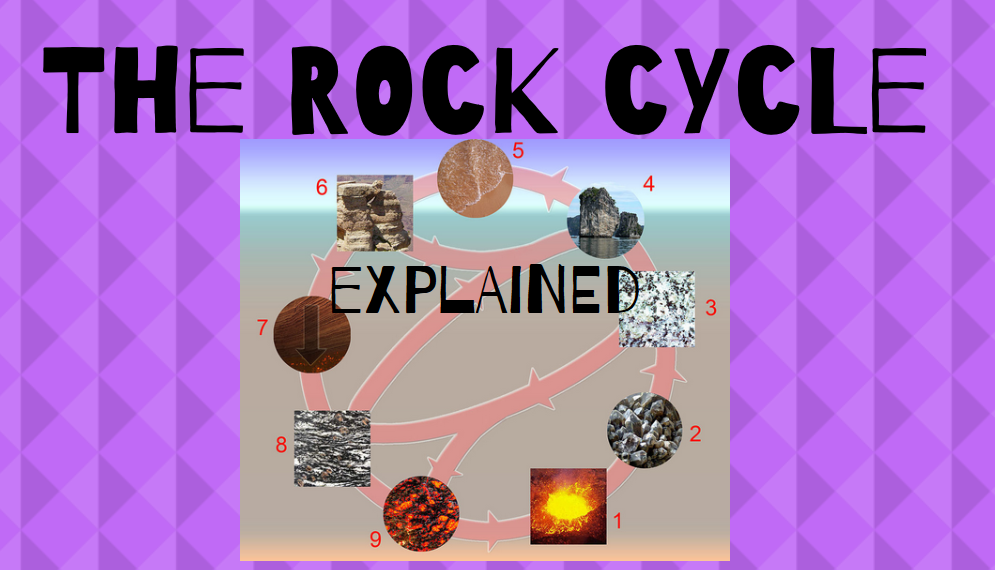
The rock cycle is a concept of geology that describes the transition of rocks between the three rock types: igneous, sedimentary, and metamorphic. The wheel outlines how each rock type tin be converted to another rock type through geologic processes.
What is the rock cycle?
Most of u.s.a. recollect of rocks every bit objects which don't change. Nosotros perceive that rocks simply continue to be every bit is, or at least we treat them equally if they do. Yet the truth is that on a geological scale, a scale of millions of years, nothing is unchanging. The rocks and the soil around us are the products of millions of years of transformation due to a variety of dissimilar geological processes. These geological processes can be referred to as the "rock bicycle."
The discovery or description of the rock cycle is ordinarily credited to James Hutton, a geologist who lived during the 18th century. Hutton is sometimes referred to every bit "the father of modern geology." Hutton noted that the process had "no vestige of a beginning and no prospect of an end." He had realized information technology was a process that had been going on since the formation of the World, and that the bicycle moves rocks, melts them, and transforms them endlessly.
"As in geology, and then in social institutions, nosotros may discover the causes of all past changes in the nowadays invariable order of society." — Henry David Thoreau
Like to the process of recycling, rocks move through a cyclical process. This procedure tin take rocks from beingness magma to beingness on the surface and experiencing erosion so back to being magma. The rock bicycle tin can produce and transform three dissimilar types of rocks: sedimentary rock, igneous rock, and metamorphic rock. How are the 3 unlike types of rock classified, and how practice they transform into each other?
In essence, geological processes tin transform one blazon of stone into another. Igneous rocks can be transformed into either metamorphic rocks or sedimentary rocks, while sedimentary rocks tin transform into both metamorphic and igneous rocks. Naturally, metamorphic rocks can transform into sedimentary or igneous rocks. Earlier we dive into the processes which transform the three unlike stone types into ane some other, it would be helpful to define some terms.
Metamorphic Rock
Metamorphic rocks are created by intense heat and pressure. The pressure and/or estrus is so intense that it tin transform the bones properties of another type of rock. Typically tectonic processes (the processes responsible for the moving of the continents) create metamorphic rocks, but they can also be created through smaller calibration collisions and pressure situations. Note that while either/both high pressure level or loftier-temperature processes tin create metamorphic rocks, one forcefulness can be dominant in the creation of them. The temperature level must also be inside a certain range as if the temperature becomes too high, igneous rocks volition be made instead.
There are two different types of metamorphic rock: foliated metamorphic and non-foliated metamorphic. Foliated metamorphic rock includes stone like schist and slate, which have prominent bands on them thanks to their exposure to high amounts of heat and pressure. Non-foliated rocks don't have bands and include things similar marble and quartzite.
Igneous Rocks
Igneous rocks are fabricated through high temperatures, hot enough to melt rocks and turn them into magma. The cooling and solidification of magma that happens over fourth dimension creates igneous rocks. Magma starts off very hot below the surface of the World, but as it is pushed towards the surface information technology begins to absurd. Rapid cooling of magma tin lead to rock formations with tiny crystals in them, while slower cooling can pb to large crystals. The most extreme form of rapid cooling is a volcanic eruption. In the case of a volcanic eruption, the magma is spewed direct into the air, and this means that the magma has a risk of bypassing the rock stage entirely and transforming into volcanic glass.
Igneous rocks are subdivided into two different categories, intrusive and extrusive. Intrusive igneous rocks are those which slowly cool below the surface, and include granite and peridotite. Extrusive igneous rock refers to those rocks which are shot out onto the World'due south surface due to a volcanic eruption, and these include obsidian (a form of volcanic drinking glass), basalt and pumice.
Sedimentary Rocks
Sedimentary rocks are created through the procedure of sediment deposit and consolidation. Sediment is whatsoever type of geological particles, particles made out of Earth, that are small plenty to be carried off and moved around by wind or water. These particles can build up in an area over time, such every bit at the lesser of a river. After the particles build upward they can join together and harden into a single sedimentary rock. Though both igneous and metamorphic rocks are created below the surface of the Earth, sedimentary rocks tin exist created while cached under a relatively pocket-size amount of soil, or even while on the surface.
Sedimentary rocks come in three dissimilar types: clastic, chemical and organic. Clastic sedimentary rocks include shale and sandstone and are commonly formed by weathering, while chemical sedimentary rocks form from a chemic precipitate and include stone table salt and flint. Finally, organic sedimentary rocks include dolomite and coal and they are formed by the aggregating of organic debris like dead leaves or animals.
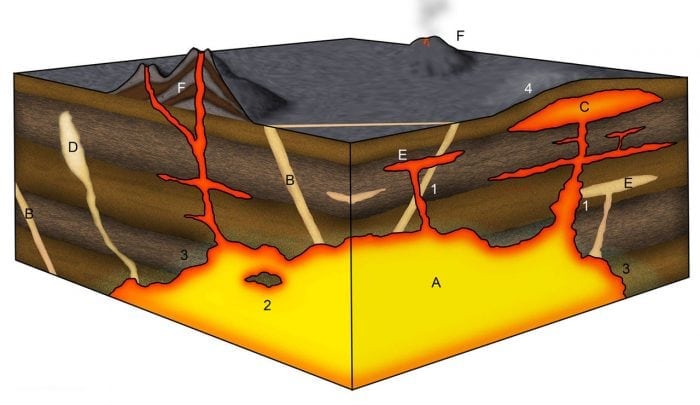
magma chamber (batholith) (A); dike (B); laccolith (C); pegmatite (D); sill (Eastward); stratovolcano (F) Photograph: Woudloper , Public Domain, Wikimedia Eatables
Transitions Betwixt Rock Types
As hinted at above, the transition betwixt rock types can happen due to a variety of processes. Metamorphic and sedimentary rocks tin get igneous rocks by being turned into magma at loftier temperatures, which usually takes millions of years to happen. Metamorphic rocks are created through temperature and pressure, as long as the temperature isn't too high. Metamorphic rocks can exist created through either contact metamorphism or regional metamorphism. Regional metamorphism happens as geological regions nail together, like at mountain ranges, which creates foliated metamorphic rocks. Contact metamorphism happens when rocks come close to hot igneous rocks, which ends up altering the backdrop of the rock and creates crystals. Finally, surface processes like precipitation and weathering tin can transform metamorphic and igneous rocks into sedimentary rocks.
Geological Processes Which Transform Rocks
The primary forces behind the rock bike are geological. These forces are subduction and uplifting. Uplifting refers to the pushing of rock out of the Earth's surface, creating mountains. Subduction is when one rock plate submerges beneath another plate and becomes magma deep underneath the Earth. Both subduction and uplifting are caused past plate tectonics. The continental plates which lie on the Earth'south curtain are moving. While the plates unremarkably only motility at a few centimeters a year, over millions of years this leads to massive changes in the Earth's surface. As these plates collide and skid past 1 another, certain regions collide and are pushed upwardly while other regions are pushed below.
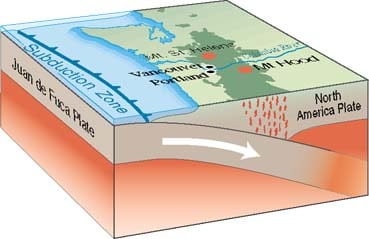
Subduction and uplifting play an of import role in the stone wheel. Here the Juan de Fuca plate moves under the Northward American plate. Photo: USGS, Public Domain
The phenomenon of seafloor spreading as well plays a role in the rock cycle. The tectonic plates which collide with each other are past necessity pulling away from each other in other areas. This means that magma is released from the World where the plates are dividing, deep in the ocean. This phenomenon leads to the cosmos of more seafloor along with metamorphic rocks and igneous rocks.
Surface processes similar weathering also contribute to the rock cycle. Wind and rain can wear away and rocks over fourth dimension, breaking autonomously igneous and metamorphic rock structures into modest particles which then join together to create sedimentary rocks.
Our globe'south geology is driven by processes that have been going on since the formation of the Globe. Every rock you run across, from the smooth stones in the riverbed to the mountains in the altitude, is role of the ongoing cycle.

Source: https://sciencetrends.com/rock-cycle-definition-diagrams-examples/

Post a Comment for "Show What You Know the Rock Cycle Worksheet"